


English
 4 min Reading time
 We often hear about 'grid congestion' in the news; the problem that our power grid would become overloaded due to the energy transition. More and more people are having charging stations and heat pumps installed, and they would need a bigger grid connection for that. The grid operators warn that the grid is already at its maximum and that for many customers upgrades of the connection are not possible for the time being. But is such an upgrade always necessary?
A heavier connection ensures that a household can draw more power, and thus can switch on more and heavier consumers simultaneously. That would supposedly be necessary if you want to charge the e-car at full power, and cook on the induction cooktop, and have the heat pump on to heat the house all at the same time. A connection that is too small could lead to the main fuse tripping, causing the entire home to go dark.
But actually such a heavier connection isn't really necessary in many cases: many appliances are smart enough to do what they need to do without overloading the main fuse too much, and in addition the home battery can make an important contribution thanks to the 'peak-load-shaving' function. How exactly does that work?
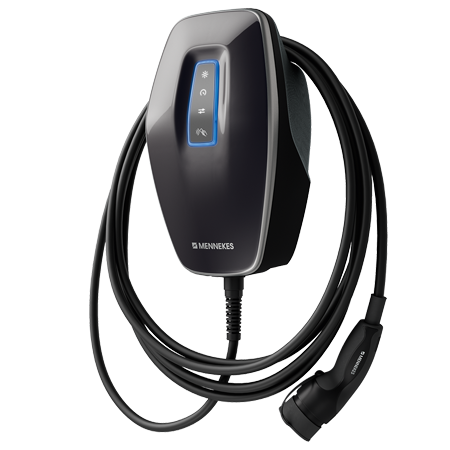
Most charging stations nowadays contain a 'dynamic load balancing' option (photo: Mennekes Amtron 4You charging station)
Most charging stations sold nowadays have a function called something like 'dynamic load management' or 'Dynamic load balancing' (sometimes also called 'blackout protection'). What that means is that the charging station has a communication connection with a power meter at the beginning of the house, near the mains connection. Thanks to that communication, the charging station can adjust very quickly if the power demand from the grid threatens to become too high. The power sent to the car is then immediately reduced, or even stopped completely for a moment.
The result is: you can always plug in your car to the charging station without having to worry. Even if you have a 'normal' home connection of 3x25 or 1x40 A, you can still charge at relatively high power and you don't have to worry about the main fuse tripping. The charging stations that Zonnefabriek installs have this function anyway, and it would be a shame to purchase a charging station that doesn't have this functionality.
Another way to protect the main fuse is possible if a home battery has been installed. Home batteries have a function called 'peak-load-shaving', or 'peak load reduction'. What that means is that the battery steps in when the power demand in the house threatens to become too high. By quickly supplying energy from the battery, it prevens the mains fuse from tripping.
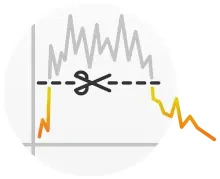
Peak load shaving ensures that peaks in power consumption from the grid are 'cut off' (source: SMA)
This function is included in the batteries that Zonnefabriek supplies, and is easy to set up. The condition is that sufficient reserve energy is stored in the battery for such moments of high power demand. That part of the storage capacity cannot then be used for other functions, such as increasing self-consumption. But it is possible to use the 'peak-load-shaving' function only in winter (when the heat pump requires a lot of power) and turn it off in summer to retain more solar power for self-consumption.
More electrical consumption at home certainly doesn't have to lead to a heavier (and more expensive) grid connection and more 'grid congestion' in the country: even with a 'normal' home connection, a lot is already possible. Want to know more about how you can get started in a smart and sustainable way? Our advisors are ready to help.