


English
 7 min Reading time
Good news for people who charge their car at home: you can get extra benefits from it. At least, if your charging station meets certain conditions. We explain how this exactly works.
Everyone who has an electric car prefers to charge at home, with their own charging station. That is advantageous anyway, but it is even more advantageous if there are also solar panels on the roof that can fill the car with 'free' electricity. In early October 2026 it appeared that home charging would become even more advantageous thanks to the existence of so-called EREs. With these we would simply be paid 5 cents for every kWh we charge in the car. Meanwhile, the rules appear to be different after all. How exactly does this work?
ERE stands for 'Emission Reduction Unit', and EREs are registered by the Dutch Emissions Authority. Suppliers of diesel and petrol are obliged to make their fuel emissions more sustainable. They do this on the one hand by selling more bio-fuels, but in addition they may also compensate part of their emissions by paying money to people who drive emission-free. The latter happens through purchasing EREs, which are traded on the market.

The EREs are supervised by the Dutch Emissions Authority
Since this year, people who charge their car at home can receive EREs for every kWh they put in the car thanks to this system. They do this by submitting the charged electricity to a so-called 'booking service provider'. They arrange the registration and sale of the EREs and pay out money based on the value of the ERE.
The rules for this system come from the Dutch Emissions Authority, or NEa. In early November they published a 'clarification' of the rules. This has consequences for the possible revenue from EREs.
Contrary to what seems intuitively logical, the electricity that private individuals generate on their own roof does not count towards the EREs. The NEa believes that EREs may only be applied to electricity from the grid, not to electricity from one's own roof. Electricity from the grid nowadays comes from renewable sources for about 55%. It is this electricity that produces EREs.
Electricity from your own solar panels is indeed 100% clean and green, but nevertheless does not produce EREs. That is strange, but unfortunately it is what it is.
To receive money from EREs, you must use a so-called 'booking service provider' as mentioned. This is an organization that registers the data of your charging sessions and handles the administrative processing. You will ultimately be paid out through the booking service provider. A list of registered booking service providers can be found here.
You report to your booking service provider how much energy (in kWh) you have charged in your car(s). You read this from your charging station (or via your charging station's app). In addition, you report how much electricity you have taken from the grid and how much electricity you have supplied back. You read this from your smart meter. The difference between consumption and supply is your net electricity consumption.
You receive EREs based on the amount of energy you have charged in the car, but this amount may never be more than your net electricity consumption! For most charging station owners with solar panels, it will apply that your EREs are calculated based on the total net electricity consumption, even if you have charged much more than that amount of energy in your car. See also the example calculation on the NEa website at the question: 'how does it work with the renewable share for private individuals?'
To benefit from this system, your charging station must have a built-in kWh meter that is 'MID-certified'. MID stands for 'Measuring Instruments Directive'. That is a European directive that guarantees the correct operation of the meter. All charging stations have a built-in kWh meter, but not all kWh meters are MID-certified.
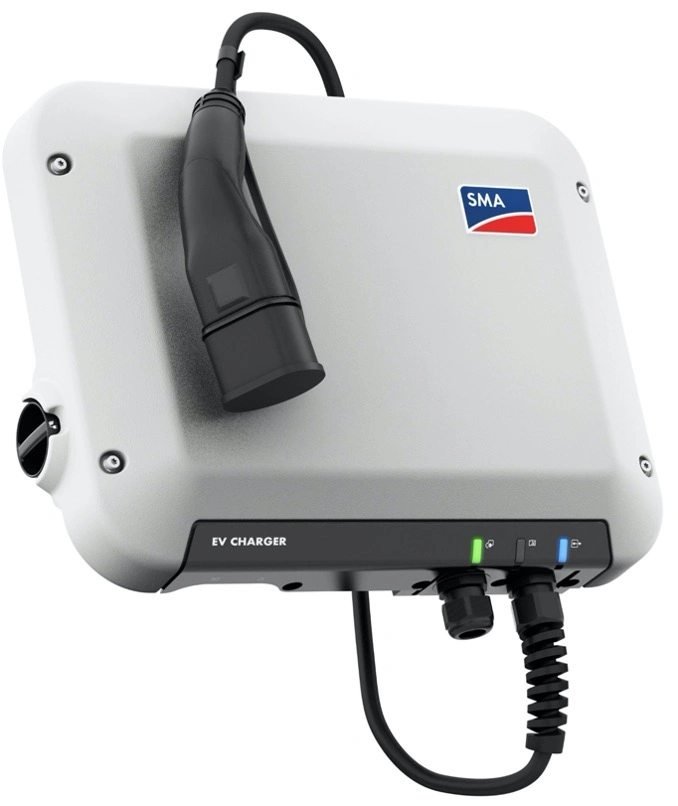
SMA EV Charger - this does have a MID-certified meter
From research by the Electric Drivers association it appears that more than half of the charging stations at people's homes do not have such a MID certified meter. Some of the charging stations that Zonnefabriek has installed also do not have a MID-certified meter. The SMA eCharger does not contain a MID-certified meter, but the (older) SMA EV Charger does. Click on the links to see an image of the meters, then you know which one you have. Replacing the existing charging station with one that does comply does not seem worth the investment for most people.

The Mennekes Amtron 4You 560 charging station has a MID certified meter and is compatible with the SMA Sunny Home Manager
Of course we immediately started looking for alternatives: a charging station that does meet the conditions for EREs, but at the same time can perform all smart functions. This involves things like: charging only the surplus solar power, charging based on dynamic tariffs, automatically switching from 1- to 3-phase charging, etc. The German Mennekes offers a solution with the 'Mennekes 4You' charging stations: robust, sleek and full of smart functions that work perfectly with your solar panels and batteries.

N.B. Number 6 in the picture shows the location of the built-in, MID-certified kWh meter. Here you can read the meter readings you need for the EREs (Energy Reduction Units).
The 'clarification' from the NEa in early November can have a considerable impact on the possible earnings from a charging station. It can help to limit the supply back to the grid as much as possible to increase the net electricity consumption a bit. But this is different for each specific situation; it is best to first calculate what your net electricity consumption currently is.
The rules about charging stations and EREs seem to change quite quickly: we therefore cannot say with any certainty that what has now been determined will still be the same in some time.
Fortunately, EREs are only one of the ways in which the charging station (and the electric car) can pay for itself. The most important thing is that with a smart charging station from Zonnefabriek you optimally use your own free solar power for your transport (instead of expensive petrol or diesel), and that in combination with dynamic tariffs you can always refuel as cheaply as possible.